


Mortgages and Market Insights: Is the Market Waiting... or Turning a Corner?


As we approach the halfway mark of 2026, one word continues to define both the mortgage and real estate markets: hesitation.
Many buyers, sellers, and investors are waiting for greater clarity before making their next move. And honestly, it's understandable.
There are several significant issues still working their way through the economy:
Ongoing tariff uncertainty
Elevated oil prices
Interest rates that appear to be near their low point
CUSMA negotiations between Canada, the US, and Mexico
Together, these factors have taken much of the urgency out of the housing market and created a widespread "wait and see" mentality.
But periods of uncertainty often create opportunities for those who are prepared.
What we are seeing in the real estate market
The market remains soft by historical standards.
Condo markets continue to struggle in many areas; land development activity is experiencing one of its most challenging periods in decades and falling rental rates have reduced cash flow opportunities for many investors.
At the same time, we are beginning to see:
More motivated sellers
Rising foreclosure activity
Increasing unsold developer inventory
Buyers gaining negotiating power
While these aren't necessarily signs of a strong market, they are often the conditions where some of the best opportunities emerge.
If prices continue to soften while mortgage rates remain relatively stable, affordability could move closer to pre-pandemic levels. And historically, that's when buyers begin returning to the market in larger numbers.
My view hasn't changed: It's not about whether it's a good market. It's about whether it's a strategy that fits your portfolio.
Bank of Canada: holding steady
The Bank of Canada once again held its policy rate at 2.25%, which sits at the lower end of what economists consider a “neutral rate”.
The challenge facing Governor Tiff Macklem and the Bank is that they are balancing two competing forces:
Inflation risks:
The conflict in the Middle East continues to keep oil prices elevated.
Higher energy prices affect transportation, manufacturing, food production, and ultimately consumer prices.
As Macklem recently stated: "If energy prices stay high, we will not let their effects become broad-based persistent inflation."
Economic growth concerns:
At the same time, economic growth remains fragile.
Canada's economy contracted slightly in the first quarter, unemployment remains in the 6.5%–7% range, business investment remains weak, and uncertainty surrounding US trade policy continues to weigh on decision-making.
Macklem also acknowledged: "If the United States imposes significant new trade restrictions on Canada, we may need to cut the policy rate further to support economic growth."
In short, the Bank is trying to balance inflation pressures against economic weakness and that is not an easy task.
Rate outlook: what we are seeing now
Variable/adjustable rates:
The outlook remains relatively stable for now:
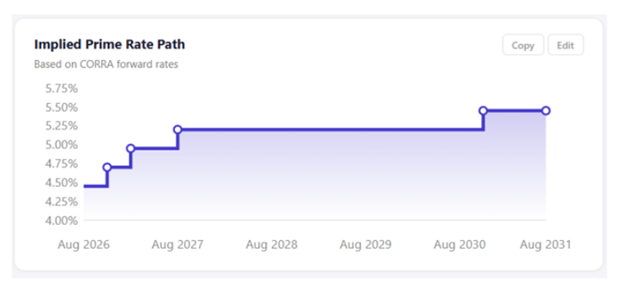
Short term: little expectation of rate cuts and rates are expected to remain flat throughout much of 2026
Medium term: Likely to go up than down in 2026, but still unclear if there will be any movement this year
Long term: Markets are now pricing in gradual increases beginning late 2026 and into 2027. The current forecasts suggest possible increase around December 2026, March 2027 and September 2027
Of course, forecasts change. Just a few months ago markets were pricing a very different path.
But today, expectations are generally pointing higher not lower.
Fixed rates:
Fixed rates remain closely tied to bond yields, which have become increasingly sensitive to inflation and oil prices.
The good news:
Fixed rates have stabilized recently
Competition among lenders remains strong
The caution:
Bond yields are expected to rise over time
Fixed rates could increase by roughly 0.5% over the next 12 months if current inflation trends continue
Longer-term forecasts suggest gradual increases of 0.10%–0.20% annually thereafter
We may not be at the absolute bottom for fixed rates, but we are likely much closer to the bottom than the top.
Fixed or variable/adjustable rate?
This continues to be one of the most common questions we are getting.
While discounted variable/adjustable rates have become more attractive recently, our general advice remains unchanged:
For most homeowners, a 5-year fixed rate currently offers the best balance of stability and long-term value.
Variable/adjustable rates may still make sense if:
You expect to sell within a shorter time frame
You need the lower payment to qualify
You have a significantly discounted variable/adjustable rate
But in today's environment, removing risk from the equation has become increasingly valuable.

Mortgage trends we are watching:
Reverse mortgages continue to grow
Reverse mortgage balances continue growing at roughly 25%–30% annually.
Many retirees are no longer viewing reverse mortgages as a last resort. Instead, they are increasingly using them as part of broader retirement and cash flow planning strategies.
Private lending has tightened
Private lenders are becoming more selective.
Land financing is extremely challenging, and many private lenders have significantly reduced or completely stopped lending on certain condo projects.
Renewals are becoming more strategic
Perhaps the biggest shift we are seeing isn't in rates, it's in how homeowners are approaching their mortgage renewals.
Historically, many borrowers simply signed the renewal offer from their existing lender and moved on. Today, more homeowners are taking a closer look at their options, and for good reason.
Some lenders are offering highly competitive renewal packages to retain clients, while others are presenting offers that may not be as competitive as what's available elsewhere in the market.
More importantly, the best mortgage solution isn't always the lowest rate.
A renewal can be an opportunity to step back and ask:
Does my mortgage still align with my goals?
Should I prioritize flexibility, payment savings, or debt reduction?
Are there opportunities to improve cash flow?
Would different mortgage features better support my plans over the next few years?
This is where having an experienced financing expert can make a meaningful difference.
With nearly three decades of experience across construction, real estate, and financing, I help clients look beyond the rate sheet and focus on the strategy behind their mortgage decisions.
We are also seeing more homeowners review their mortgage well before renewal than we have in years. That's not surprising considering 2026 and 2027 are expected to be among the largest mortgage renewal years on record, and many borrowers are understandably concerned about where rates may be heading.
If your mortgage is renewing within the next two years, now may be a good time to review your options. In some situations, securing a rate hold, refinancing early, or restructuring your mortgage can create meaningful savings and reduce future uncertainty.
It doesn't necessarily mean making a change today.
It simply means understanding your options before the market changes again.
What does this mean to you?
Markets rarely send perfect signals. They tend to shift gradually and then all at once.
Right now, we are in a period where:
Rates have stabilized, but could move higher
Home prices have adjusted, but haven't fully reset
Opportunities are emerging, but require preparation and planning
The goal isn't to predict the next move perfectly. It's to make sure you are in a strong position regardless of what happens next.
If you have a renewal coming up, are considering buying, wondering whether to stay variable/adjustable or lock into a fixed rate, or simply want a second opinion on your current mortgage strategy, now may be a good time to review your options.


Comments